Thinking of investing in Liverpool? The short answer is that Liverpool is worth investing in because it combines a large, growing economy with entry prices well below the national average, a digital and creative sector that has been one of the fastest growing in the North, and a pipeline of regeneration, from Liverpool Waters to the Knowledge Quarter, that is still only part built. According to Liverpool City Council's economic indicators, the city has an £18.4 billion GDP, 294,788 people in employment and 17,985 active businesses.
This guide pulls together the economic data, the property market, the best areas to invest in Liverpool, the digital and technology sectors, and the questions to ask before buying a Liverpool business or property. As an SEO specialist who works with Liverpool businesses, I have also included a section on the digital marketing market, because whatever you invest in here will need to be found online.
| Key Economic Indicators | Value | Source |
|---|---|---|
| GDP Total | £18.4 billion | Liverpool City Council |
| GDP per Head | £40,392 | ONS Census 2021 |
| Active Businesses | 17,985 | Liverpool City Council |
| Employment Growth Rate | 10.61% | Liverpool City Region |
| Population | 508,961 | ONS Census 2021 |
These are the latest figures I have quoted here; for current numbers check Liverpool City Council's economic data pages and the ONS.
Liverpool City Council's business data shows 17,985 active businesses, a density of 431 per 10,000 residents, which indicates a healthy entrepreneurial environment. The ONS Census 2021 puts GDP per head at £40,392, competitive within the UK, and shows 9.3% population growth over the previous decade, a sign of sustained expansion that supports business development.
Employment statistics from the Liverpool City Region are particularly strong. Employment stands at 294,788 with 10.61% growth, well ahead of national averages. That labour market expansion creates a robust consumer base and healthy fundamentals for anyone investing in a Liverpool business.
Liverpool Chamber of Commerce research identifies Professional Business Services (PBS) as the city's economic powerhouse, generating an estimated £36.98 billion in turnover through 12,545 companies. The sector covers legal, accounting, consulting, advertising and management services and forms a critical part of the city's economic infrastructure.
| Business Sector | Number of Companies | Annual Turnover/GVA |
|---|---|---|
| Professional Business Services | 12,545 | £36.98 billion |
| Wholesale & Retail Trade | 5,451 | N/A |
| Construction | 4,480 | N/A |
| Digital & Creative | 6,500+ | 52% growth |
| FinTech Companies | 42 | £218.6 million |
The Liverpool City Region Plan for Prosperity evidence base shows the sector's significance extends beyond its direct contribution: it supplies the support services that enable growth in life sciences, advanced manufacturing and the creative digital sector. Chamber analysis suggests that targeted investment of £1.6 million a year over five years in PBS could yield exceptional returns and create between 1,000 and 1,500 new jobs.
Business registration data shows a well diversified economy: wholesale and retail trade leads with 5,451 companies, construction follows with 4,480 and professional activities with 4,444. That spread gives the city resilience against sector-specific downturns.
The British Chambers of Commerce Quarterly Economic Survey shows mixed conditions. Manufacturing and production have been under pressure, with 27% of firms reporting declining sales, while marketing, media and advertising businesses have performed strongly, with 42% reporting increased sales. The direction of travel favours digital services and the creative industries.
Liverpool's property market has shown steady rather than spectacular growth, which is exactly what makes it interesting for investors who want yield and headroom rather than a late entry to an overheated market. Blue Row Homes' research put the average house price at £186,000 as of September 2024, a 1.3% annual increase, modest against the North West's 4.8% rise but a sign of stability and affordability. Property investment specialists at Investropa had forecast around 20% price growth between 2023 and 2025; that forecast period has now ended and I have not independently verified the outcome, so treat it as a historical projection rather than a current fact.
| Property Metric | Current Value | Market Outlook |
|---|---|---|
| Average House Price (2024) | £186,000 | Stable |
| Annual Price Growth | 1.3% | Moderate |
| Price Forecast (2023-2025) | +20% | Strong Growth |
| Average Monthly Rent | £801 | Rising |
| Annual Rental Growth | 8.4% | Strong Growth |
| Office Space Transactions 2024 | 318,479 sq ft | Expanding |
Figures in this table are from late 2024 reports; the Land Registry UK House Price Index and the ONS private rent series carry the current numbers. The growth trajectory is driven by substantial infrastructure investment, including the £5.5 billion Liverpool Waters development and regeneration projects that have attracted over £550 million in private investment.
Fisher German recorded 318,479 square feet of office space transacted in 2024, a 12.5% increase on the previous year, which points to strong demand for commercial space and business confidence in Liverpool as a place to expand.
The constraint is premium stock. Fisher German's experts note that "a lack of high-quality office space is expected to limit large-scale transactions". That shortage supports rental growth and creates opportunities for developers, while making life harder for businesses that need Grade A accommodation.
Blue Row Homes' private rental research shows strong momentum: average monthly rents reached £801 in October 2024, an 8.4% annual increase, and their five-year analysis shows rents rising from £757 in 2020 to £1,028 in 2025, a 35% rise in line with national patterns.
Supply constraints continue to drive rental growth, with availability nationally around 25% below pre-pandemic levels. Local letting agents report consistently strong tenant demand and low vacancy rates across the city, even after the frenzy of 2022 and 2023 calmed.
Liverpool is a city of distinct districts, and the right one depends on whether you are buying a business, commercial space or residential property. These are the areas that come up most often in investor conversations, with an honest note on each. I am not giving price predictions; do your own numbers.
The former warehouse district south of the city centre became Liverpool's creative and digital quarter, home to studios, agencies, breweries and venues. It has been developed heavily over the past decade, so the easy gains have gone, but demand for workspace and city-living apartments remains strong and the new Baltic railway station, when delivered, will add connectivity.
Anchored by the universities, the Royal Liverpool University Hospital and the Liverpool School of Tropical Medicine, the Knowledge Quarter is the focus of the city's life sciences and health innovation push and sits within the Investment Zone. Paddington Village is the flagship development. It suits businesses in science, health, education and the professional services that support them, and residential demand from staff and students is deep.
Bold Street, Seel Street and the surrounding streets carry Liverpool's independent retail and hospitality, with Liverpool ONE a few minutes away. City-centre apartments here let quickly to young professionals and students, and footfall supports retail and leisure businesses. Watch service charges and leasehold terms on newer blocks.
The £5.5 billion Peel Waters scheme is transforming the northern docks with offices, apartments, hotels and public realm, and it will take years more to complete. Early phases around Princes Dock are established; later phases are where the long-term upside sits, with the timing risk that comes with any large master plan.
Everton's move to its new stadium at Bramley-Moore Dock in 2025 has brought investment, visitors and attention to the north docks and the neighbourhoods behind them, while the long-running Anfield regeneration around Liverpool FC's stadium continues. Entry prices here are among the lowest in the city, which attracts yield-focused landlords, but these are regeneration areas with the mixed streets that implies, so inspect carefully.
Established, leafy and family oriented, with good schools and Sefton Park on the doorstep. Capital growth tends to be steadier and yields lower than in the centre, and these suburbs suit owner-occupiers and businesses that serve affluent local customers, from dentists to estate agents. I wrote more about local demand in these areas in my guide to local SEO for Liverpool businesses.
Liverpool has been one of the most searched-for UK cities for property investment for a decade, and the appeal is straightforward: lower purchase prices than the South and the Midlands, consistently strong rental demand from students and young professionals, and gross yields that have historically been above the national average in the central postcodes. Set against that are some specific risks worth naming.
Taken together, Liverpool remains a sound choice for a yield-focused investor who does the homework, and a reasonable one for capital growth over a long horizon, especially around the regeneration zones described above.
Liverpool City Region's digital strategy identifies the digital and creative sectors as the city's most dynamic growth area, with 52% GVA growth, the second largest among northern cities. Liverpool John Moores University's scale-up research puts the sector at around 6,500 companies employing over 51,000 people, including 20,000 freelancers.
Invest Liverpool's Tech Climbers review shows ambition across the sector, with 79% of featured businesses seeking funding and over 240 jobs projected. The region's 212km full-fibre, gigabit-capable network provides the connectivity that digital businesses need.
White Cap Consulting's Liverpool City Region FinTech Ecosystem Report 2023 found the sector generating an estimated £218.6 million of GVA annually through 42 dedicated FinTech firms, 79% of them startups and scaleups, with particular strength in payments, WealthTech, accounting and InsurTech. CIRCA5000 (formerly tickr) raised over £12 million and achieved national recognition.
The sector draws on Liverpool's long financial services heritage, especially in wealth management, and on applied capability in artificial intelligence and data analytics from the universities. Investec, Rathbones, RSA, Barclays, Santander and The Very Group all maintain significant operations in the region.
Liverpool City Region development plans list 107 innovation assets and projects. The city is one of 12 UK Investment Zones, Freeport status provides further incentives, and the Hartree National Centre for Digital Innovation at Sci-Tech Daresbury offers advanced computing, data and AI capability with partners including IBM Research, Atos and Intel.
The region's prosperity plan targets 5% R&D investment annually by 2030, nearly double the national target, with an estimated £41.7 billion gross GVA benefit and 44,000 new jobs by 2030.
With 17,985 active businesses in the city and 24,790 SMEs in the wider area, the potential client base for digital marketing in Liverpool is substantial, and more than 20 established SEO agencies compete for it. This is relevant to any investor: whatever you buy here will need to be found online, and the quality of a business's search presence is part of its value.
| SEO Market Segment | Market Size | SEO Opportunity Level |
|---|---|---|
| Professional Services | 12,545 companies | Very High |
| Property & Real Estate | 20% growth forecast | Very High |
| Healthcare & Life Sciences | Investment Zone focus | High |
| E-commerce & Retail | 5,451 companies | High |
| FinTech & Financial Services | 42 + major brands | High |
Local search has become decisive for Liverpool businesses. Over 80% of searches now happen on mobile devices, which means mobile-first sites and local optimisation for Liverpool and the surrounding areas: Wirral, Chester, Southport, Runcorn, Warrington and Wrexham. The Professional Business Services sector, with its £36.98 billion turnover, is a particularly valuable market, because legal firms, accountancy practices, consultancies and agencies need sophisticated digital marketing to compete.
Local Liverpool SEO specialists such as myself see the same pattern every month: businesses without a properly set up Google Business Profile do not appear in Google Maps when customers search in the Liverpool area, and businesses with one win enquiries they never had to advertise for. My look at digital marketing in Liverpool goes into the channels that work here.
The Liverpool SEO market has healthy competition, from local specialists to national players, serving everything from sole traders to multinationals. Price competition runs from moderate to high, service quality varies widely, and that variation creates openings for providers who can demonstrate clear return on investment and transparent reporting. Technical SEO expertise is in particular demand: Core Web Vitals, mobile-first design and, increasingly, optimisation for AI search.
Healthcare and life sciences companies, boosted by Investment Zone status, need SEO that respects regulatory requirements while maximising visibility for specialist services. The property sector needs strategies built on high-value search terms and local market expertise, from estate agents to developers and letting agencies. Tourism and hospitality businesses benefit from Liverpool's cultural destination status, with Beatles tourism and the waterfront creating distinctive search demand from both locals and visitors. E-commerce and retail businesses face competition from national chains and need product page optimisation, local inventory visibility and multi-channel integration.
Legal firms in Liverpool compete intensely for terms such as "Liverpool solicitor" and "personal injury lawyer Liverpool", and need thorough local SEO built on Google Business Profile optimisation, citations and content that demonstrates legal expertise. Accountancy practices benefit from seasonal campaigns around tax return deadlines and year-end accounting, with content aimed at both individuals and the city's large SME base.
Medical practices and healthcare providers must balance visibility with compliance, prioritising authoritative content that demonstrates expertise while adhering to advertising standards. Private providers targeting Liverpool's professional demographic typically combine paid search with organic SEO and extend their targeting to Wirral and Chester. My guide to SEO for dentists in Liverpool is a worked example.
If the investment is a trading business rather than bricks and mortar, the usual due diligence applies: accounts, contracts, staff, leases, licences. From my own corner of the market, I would add a digital checklist, because a surprising amount of a small business's value now sits in its online presence and it is rarely examined properly.
A pre-purchase SEO audit answers all five and costs from £1,000, which against the price of most businesses is cheap insurance.
Liverpool's startup ecosystem has matured: the city has been ranked 9th globally for hosting a thriving startup environment, supported by accelerators including Baltic Ventures and networking organisations such as Startup Grind. Angel investment is the dominant funding source at 67% for the city's tech businesses, and 34% of entrants are bootstrapped, which says something about local resilience.
Liverpool John Moores University research identifies 590 scale-up businesses currently supported in the city region, where micro and small enterprises make up 97.7% of the economy. That is a deep pipeline for growth, and sustained demand for professional services, including digital marketing and SEO.
The Liverpool City Region Local Skills Improvement Plan has built a business support infrastructure around partnerships between chambers of commerce, colleges and training providers. Liverpool Chamber of Commerce plays a central role in advocacy and networking, and its quarterly economic surveys inform policy locally and nationally. The latest surveys show taxation as a concern for 48% of firms, alongside inflation pressure and investment confidence.
Networking opportunities are plentiful through Professional Liverpool, Pink Link Liverpool and sector-specific groups, and the Liverpool Business Expo attracts around 150 exhibitors and 1,800 visitors a year. I keep a current list in my guide to business networking events in Liverpool.
The Chamber's surveys also flag the headwinds. Taxation has become the primary external worry for 48% of firms, up from 36% in Q2 2024. Recruitment is difficult, with 59% of Liverpool businesses attempting to hire reporting problems, particularly for professional, managerial and skilled technical roles. That skills shortage is an opportunity for businesses that can attract talent and a constraint for those that cannot.
Premium office space remains scarce. As Fisher German put it, "until we begin to develop and build top quality developments as seen in Manchester, Birmingham and London, we are never going to realise the rental levels that these cities enjoy." That may limit the city's ability to attract the largest national and international occupiers in the short term.
The digital skills shortage hits the tech sector hardest, with software development, data analytics and digital marketing roles the hardest to fill. That creates opportunities for training providers and supports higher salaries for qualified digital professionals, which in turn attracts talent from other regions.
Developers identify Grade A office space with modern amenities, sustainable building certifications and excellent transport connectivity as the requirements for attracting large-scale investment. Liverpool Waters aims to meet them through mixed-use commercial and residential development, but completion timelines run into the late 2020s and beyond.
Liverpool is a city in transition, balancing traditional economic strengths with emerging digital opportunities. Stable fundamentals, a growing digital sector and substantial infrastructure investment combine into a compelling environment for business growth and expansion, and for the investors who back it.
For SEO professionals and digital marketing providers, 17,985 active businesses are a target-rich environment, and the £36.98 billion Professional Business Services sector is especially attractive for anyone who can deliver sophisticated, results-driven campaigns.
Liverpool SEO market analysis: competition levels, sector opportunities, mobile dominance and growth projections for digital marketing services.
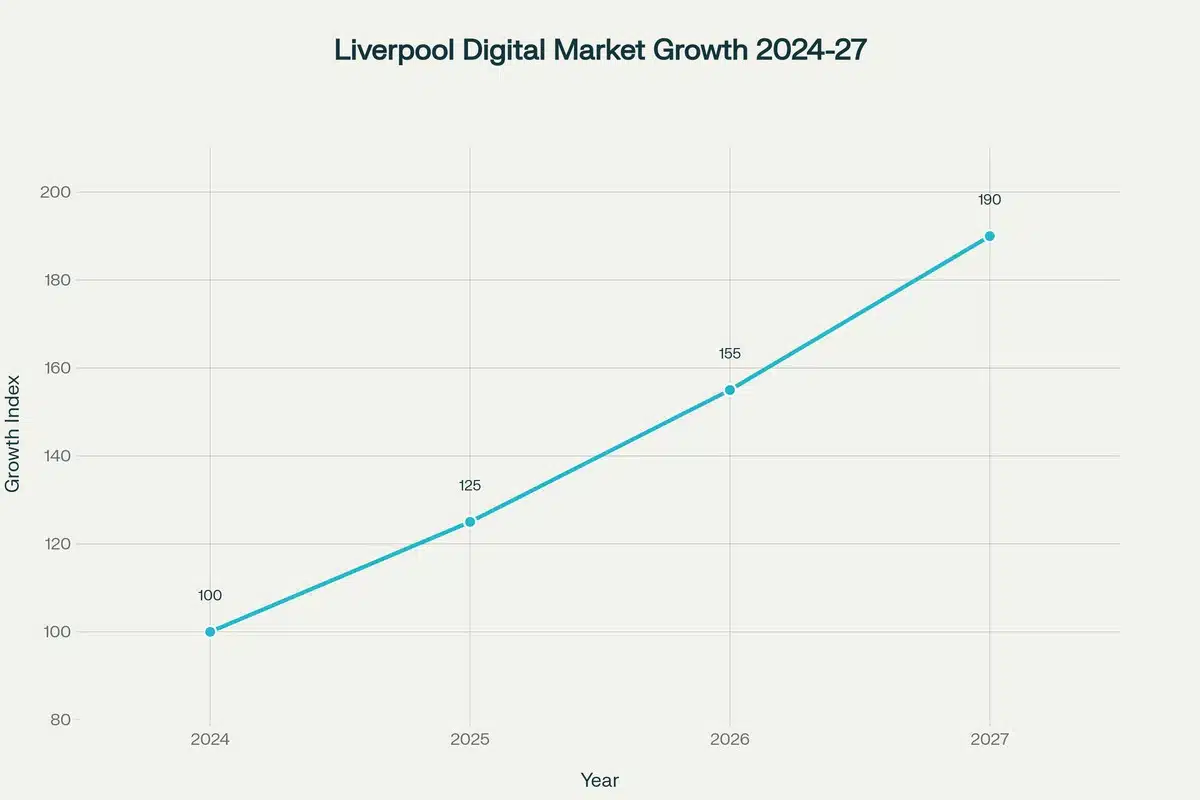
The 52% growth in digital sector GVA shows that Liverpool businesses understand digital transformation, which sustains demand for SEO that can demonstrate clear return. Mobile accounting for 80% of searches means mobile-first strategies and local optimisation are the baseline, not an extra. And the prosperity plan's £41.7 billion GVA target by 2030 suggests Liverpool will keep attracting businesses that want a modern, connected base.
The commercial development pipeline means new businesses will keep arriving in Liverpool, with ongoing demand for local SEO and digital marketing, and 8.4% rental growth shows strong demand for space and confidence to invest. The immediate opportunity for SEO providers lies with the 12,545 Professional Business Services companies, many of which run traditional service models and are only now learning what digital marketing can return. E-commerce and local retail are the other near-term opportunity, needing omnichannel strategies that join physical and digital presence to compete with national chains.
Foreign direct investment targets of 30% growth by 2030 suggest Liverpool will attract more international businesses needing local market expertise and UK-focused digital strategies. FinTech's projected growth on its £218.6 million GVA base creates demand for compliance-aware financial services marketing. Healthcare and life sciences, backed by Investment Zone status, will need specialist digital marketing that respects healthcare regulation while delivering measurable results.
Liverpool's combination of economic stability, digital innovation and strategic investment makes it an attractive location across sectors. For digital marketing providers, the winning position is sector-specific expertise, particularly in Professional Business Services, FinTech and healthcare, combined with technical capability in Core Web Vitals, mobile-first design and AI search optimisation. The ability to show a deep understanding of client industries will separate successful providers from generic agencies.
Yes, with the usual caveats. Liverpool offers an £18.4 billion economy, a growing digital and creative sector, Investment Zone and Freeport incentives, strong rental demand and entry prices below the national average. The risks are specific rather than general: regeneration timelines that slip, a shortage of Grade A offices, property licensing rules and a history of failed off-plan schemes. Investors who buy finished stock, check licensing and do proper due diligence have done well here.
Entry prices. Liverpool's average house price of around £186,000 in late 2024 was well below Manchester's, while rental growth of 8.4% and a 35% rise over five years show demand keeping pace. The city also has more regeneration still to come, including Liverpool Waters and the north docks, so there is upside not yet reflected in prices. Manchester has the larger corporate office market; Liverpool has the better yields and the lower ticket.
For businesses and workspace: the Baltic Triangle, the Knowledge Quarter and Paddington Village, and the L1 city centre. For residential yield: central postcodes around Ropewalks, the Knowledge Quarter and the regeneration areas of Anfield and the north docks. For steadier capital growth and family demand: Allerton, Aigburth and Woolton in south Liverpool. Each has different risks, covered in the area guide above.
Liverpool has been a favourite of yield-focused landlords for a decade because of low purchase prices and strong demand from students and young professionals. Check Liverpool City Council's selective licensing and Article 4 rules before buying, favour finished developments from established developers, read leasehold terms and service charges carefully, and remember that purpose-built student blocks now compete with converted houses near the universities.
Invest Liverpool handles inward investment for the city council, Growth Platform is the city region's growth company with advice, grants and programmes, and Liverpool Chamber of Commerce offers networking, representation and its quarterly economic surveys. The Investment Zone and Freeport bring tax and planning incentives for qualifying sectors, and the universities run accelerator and innovation programmes, including Baltic Ventures for tech startups.
Any business you buy or build in Liverpool depends on being found by local customers, and over 80% of those searches now happen on mobile. Before buying, audit who owns the domain and Google Business Profile, what the site ranks for, its reviews and its technical health. After buying, local SEO is usually the cheapest reliable source of new enquiries. I run audits from £1,000 and local SEO campaigns at £550 plus VAT per month.
I am an SEO specialist based in Ness, Wirral, ten minutes from the Mersey, and I work with businesses across Liverpool and the city region. If you are buying, launching or growing a business here and want it to show up when Liverpool customers search, get in touch or start with my SEO Liverpool page. For the geography behind the business case, see what county Liverpool is in.

Opening hours
Monday: 09:00 - 18:00
Tuesday: 09:00 - 18:00
Wednesday: 09:00 - 18:00
Thursday: 09:00 - 18:00
Friday: 09:00 - 18:00
Company info
Graham SEO Ltd
Company No.10710878
VAT No. 349888132
Office 2, Oaktree Court Business Centre
Mill Ln, Little Neston, Ness
Wirral, CH64 8TP
Copyright © Graham SEO Ltd 2026. All Rights Reserved